

nbc6.net
Wednesday, December 3, 2008, 12:07 am
Ari Odzer & Ron Magill take a
student on the trip of a lifetime.

Search 
Search IBS  Search the Web
news
E-Mail News Alerts
Get breaking news, daily headlines and more.
More

Smuggled At Sea

by NBC 6 Reporter Tom Llamas

POSTED: 2:18 pm EST February 19, 2008

From sunset to sunrise on February 15, I witnessed a dramatic high-speed opera that unfolds in the Florida Straits nearly every night.

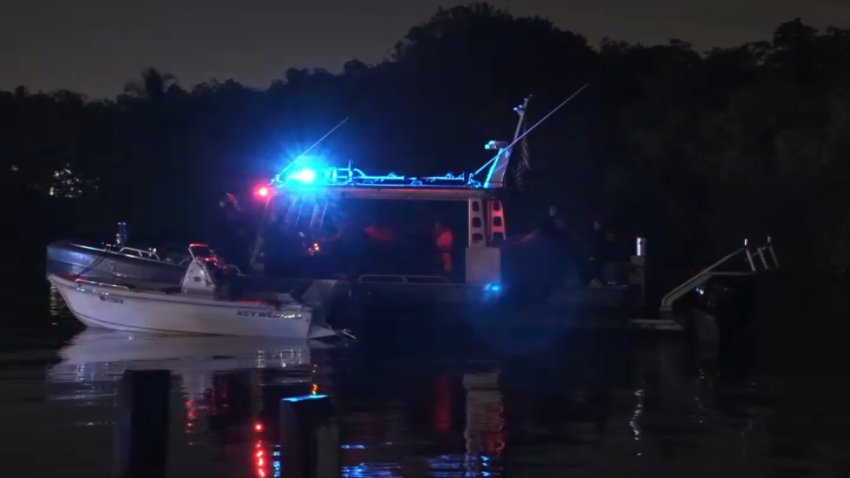
NBC 6 photographer Steve Paine and I were given unlimited access to the Coast Guard's interdictions of alleged human smugglers racing into South Florida with go-fast boats filled with Cuban nationals.

Related Content: Images | Raw Video

Our night started when the coast guard's Evan Sanborn got the call from sector Key West that a go-fast boat with 15 to 20 Cubans was headed for the Florida Keys.

"We're in route to the Dry Tortugas where an aircraft is over a go-fast boat with 15 to 20 persons on board. It's going to be close," said Sanborn.

He's the coxswain of a special purpose craft (SPC). It's equipped with a steel cabin, infrared camera and three 275-horsepower Mercury outboard engines. It's a tank that can fly over water. A boat the Coast Guard built a year and half ago to chase down smugglers. In 2005 when smugglers went full throttle -- using "go fast" boats as a transport method -- the Coast Guard couldn't keep up. Not anymore.

"We have an advantage over the boats we're chasing,” said Sanborn. "We're coming down the north we're closing distance.

Sitting up front inside the cabin with Sanborn is Chris von Rautenkrnz - the boat's eyes and ears. "Von," as he's called, mans the radio and infrared camera -- a device worth about as much as the boat. It projects a crystal clear picture of the open sea in the dead of night.

"I can move 360 around the boat. There is a sensor at the top with the camera. I can see anything that is out in front of us right now, " says Von. "It's exactly like a video game."

The cabin stays dark throughout the chase ... lit by only a few sensor lights. We had to document the beginning of the chase with a night vision camera. Sanborn's goal is to spot the smugglers before they spot him.

"If they can see land they're going straight to land."

As Sanborn and crew close in on the go-fast, the command center in Key West is relaying the alleged smugglers' speed and exact position.

At this point in the cat and mouse game, the Coast Guard is one step ahead because they have a Falcon jet in the air that is following the go-fast.

"The easiest thing for us to spot is the wake," says Captain Stephen Mehling from Coast Guard Air Station Miami. We flew with Mehling and his crew earlier in the month to get a sense of how the air operation works.

For Sanborn, the Falcon is the eye in the sky.

But even with air assets and intelligence coming out of Key West, Sanborn cannot make a mistake because in this chase the alleged smugglers are only 12 minutes from U.S. soil in the Dry Tortugas.

Suddenly Von shouts out, "Got him."

"Where?" asks Sanborn

"On the port side. Light him up," replies Von.

For the first time, Steve and I spot the go-fast, the spotlight bouncing and shining off the high speed boat and it's wake.

Coast Guard translator Carlos Camacho runs to the front of the SPC and gets on the loud speaker:

"Guarda Costa de los Estados Unidos. Para tu barco." Translation: "United States Coast Guard. Stop your boat."

The alleged smugglers ease the throttle.

"He's coming down. Get on board," shouts Sanborn.

I push to the front of the cabin and right in front of my eyes are 33 Cubans, all crammed into a 32-foot scarab go-fast boat. A boat like that can safely transport 8 to 12 people.

The Cubans have their hands up on their faces -- looks of confusion, disbelief and sadness. Some don't understand what's happening. Others realize their dream of freedom has just ended.

Camacho and Von board the boat. Other crew members with weapons drawn look on from the SPC.

Aboard the go-fast are, men, women, even children. As the Coast Guard starts a head count and handcuffs the alleged smugglers, the Cubans start to get sea sick. Many of them start throwing up in the boat, especially the children.

One of the Cubans tells Camacho: "Pa Cuba yo no voy ni muerto." Translation: "I won't go back to Cuba, not even dead.

Camacho explains it's not up to him. He tells the Cubans the U.S. government will interview all of them aboard a larger ship.

U.S. policy firmly states that Cubans who reach dry land can stay. Those intercepted at sea are repatriated. However, during the interview process, the government can "dry foot" Cubans intercepted if it is determined there is a credible threat against that person's life upon returning to Cuba.

Once the alleged smugglers are in custody and the Coast Guard has a firm head count, the Cubans are then transferred to a platform vessel. It's aboard that ship where they are held until the government decides their future.

On the platform vessel, the Cubans are fed and given white clothes. If they need medical attention, the Coast Guard provides it. When we reached the platform vessel the first time, I saw about 100 Cubans who had been previously interdicted. They looked on to see who was coming aboard. When they saw our camera they waved and flashed peace signs.

"It's heartbreaking they are going through the situation," said Camacho. "As a father it makes you feel bad that they have to be put in that situation."

Captain Scott Bushcman who commands the Coast Guard sector Key West, told me they had 380 go-fast events in 2007. That means the Coast Guard deals with smuggling on a daily basis.

Contrary to rumors that spread after interdictions, we never saw the Coast Guard handle any of the Cubans inhumanely. In fact, Sanborn's crew remained calm throughout the chase and boarding of the vessel.

"The Coast Guard doesn't make policy, it enforces policy," said Admiral David Kunkel. He commands the entire Coast Guard fleet in South Florida. On more than one occasion, he's made a plea to the Cuban-American community to stop funding smuggling operations.

"It's, I believe, organized crime. There is money to be made by going into Cuba, picking up people at $10,000 head and bringing them towards us," Kunkel said.

Kunkel said the Coast Guards' stepped up presence in the Florida Straits has forced smugglers on go-fast boats to drive as far as Mexico to drop off Cubans who then cross the border into Texas.

"We need the cooperation of the local community it is dangerous. We believe 65 plus have lost their lives in the last year," said Kunkel.

For him, it's not so much that go-fast smuggling has gotten so widespread that it has taken over the Coast Guard's law enforcement operations in South Florida... it's that certain people are still unaware of the dangers of smuggling.

Go-fast boats filled with Cubans have flipped over and countless people have lost their lives. Many times the alleged smugglers are inexperienced to drive any boat during any hour of the day.

"Most of the smugglers we see have been in this country less than six months. They have no idea how to drive a boat," said Sanborn.

The Coast Guard handed out life vests during the interdictions because the alleged smuggler didn't have enough life vests on board.

A few hours after our first interdiction, we were back on the hunt for another go-fast.

During the winter, the Coast Guard says smugglers look for "weather windows," opportunities when the seas are calm.

During our second chase, the alleged smugglers tried getting away after spotting the SPC. When Von and Camacho boarded, they found over 20 cubans jammed pack on the go-fast.

Among the passengers, a 9-month-old baby boy clutched in the arms of his grandmother. When the Coast Guard stopped the go-fast, the baby was wearing nothing but a diaper.

Seeing that baby reminded me of the risks Cubans will take to get America.

How could the mother of that child allow an infant to be put on a go-fast?

I got the answer when I met the baby's mother, Anneli Mendiuve. I showed her the video we had shot over the previous weekend. she broke down immediately after the first few shots. It turns out one of the alleged smugglers from the second boat is her husband. She thinks he went back to Cuba to pick up their baby.

"In Cuba we constantly struggle. There were times I couldn't even get milk for my baby," Anneli said.

She told me at one point the baby was so sick that no doctor in their hometown of Pinar del Rio could treat her child. She had to take the baby to Havana and had to use a false name in order to obtain medical services for the baby.

"Since I've been here I've lost weight. I can't sleep. I even have thoughts of returning to Cuba. I'm not happy here because I didn't think it would be so difficult being here without my child," said Anneli.

She says her husband is not a smuggler. He told her the morning he left that he was going fishing. She thinks he was trying to reunite the family. She believes the policy, not the money, fuels smuggling.

"This is never going to end. Even if they catch them all, they'll try coming back. And next time maybe they'll drown. And it'll keep happening," Anneli told me.

She and her husband hardly live like multimillion-dollar smugglers. They rent an efficiency in Hialeah that is about 10 feet by 12 feet with a bathroom.

Authorities believe the drivers of go-fasts, like Anneli's husband, are not the top money men in the smuggling operations.

With smugglers charging up to $10,000 a head, someone else is clearly getting rich.

Reflections:

NBC 6's Tom Llamas

Growing up Cuban-American, it was a surreal experience to witness the interdictions.

My parents came to the United States in the 1960s, after Fidel Castro took over Cuba.

My Dad was smuggled through Mexico on the Rio Grande. He and his sister, not even teenagers yet, were put on a raft with a Coyote (a Mexican smuggler). It's an experience my father has never forgotten.

Every time I looked over at one of the go-fast boats, I pictured my father making the trek into the United States.

These people were risking their lives for something I experience on a daily basis: freedom.

By law, we were not allowed to speak to the Cubans or alleged smugglers. It was difficult. I wanted to shout out a thousand questions because I know the people on board those boats had a thousand stories for me.

What they couldn't say they expressed with the looks on their faces. I witnessed the evolution of emotion -- from shock to confusion to despair to sadness.

Seeing the Coast Guard hand off Cuban children to other coasties on the platform vessel is an image that will stay with me forever. Though the parents were brought up right after their children, there is that moment when the child is unclear of what is happening and thinks they are being separated from their mother or father.

The reality for most Cubans who reach the platform vessel is that they are one step close to repatriation -- being sent back to the country they risked their lives to escape.

Before, during and after the interdictions, I got a chance to get to know the crew I was embedded with. They were a group of young men -- most husbands and fathers. They all are based in Key West so they live near the base. They told me about their families and future plans. When you're on a boat for 15 hours with someone you get know that person.

I mention this because at times rumors circulate about the inhumane way the Coast Guard handles Cubans who are interdicted. Though I can only speak for the team I was embedded with, I can say at no point did I ever witness the Coast Guard acting improperly in the handling of the interdicted Cubans. The only time the men even raised their voices was when they were stopping the go-fasts and during the arrests of the alleged smugglers.

The Coast Guard wants to stop the money flow in hopes it will slow down the smuggling operations. But the mother whose 9-month-old was interdicted told me that Cubans will never stop coming to the U.S. until the policy changes.

She says it has nothing to do with money and everything to do with freedom.

--

E-mail Tom: tom.llamas@nbcuni.com.

Sponsored Links


Links We Like
Sponsored Content
Herpes simplex is more common than you’d think. Learn to recognize the 5 types. More

A little short on space? Learn how to make the best of your limited square footage with these helpful tips to better small home style. More

If you’re worried about STD’s it’s important that you know the telltale signs. Check out the 8 signs that you may have an STD. More

Your bedroom is your sanctuary. Make it a stylish sanctuary with these twelve tips. More

Don’t be left out. Make the switch to Digital TV.

Consumer Info


Sponsored Content Provided by ARA

Portions 2008 Internet Broadcasting Systems, Inc. All rights reserved.
Terms of Use | Privacy Policy | Advertising Information | Contact Us